
“You live on a boat?! How is that? Does it move all the time? How does the weather affect you? Where do you keep your stuff? Do you have electricity? How about fresh water? Do you have a real kitchen? How do you deal with waste? Are you connected to cable and WiFi? Does your dog like living on a boat? What happens when you go sailing?”
How about fresh water? Fresh water is essential to life. Living on a boat is considered “roughing it” by some, but I am not only equipped with the crucial elements taken for granted by land-lubbers, I am able to generate my own electricity (as shared last week) and water.
Having access to clean, drinkable water is something that most people in America (and other developed countries) take for granted. In a house, you turn on a faucet and clean water flows! It’s not that simple on a boat. When we are traveling in foreign waters, it is vital that we have the ability to obtain and stock clean water, either by purchasing on land or collecting and/or making onboard.
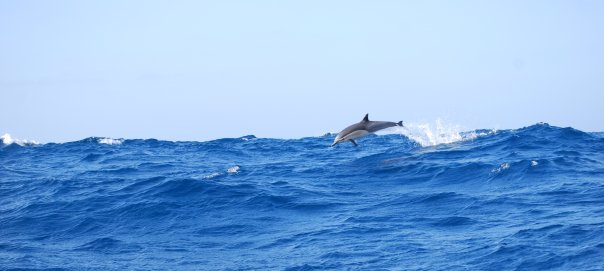
Water water everywhere and not a drop to drink – James Casey, Poet
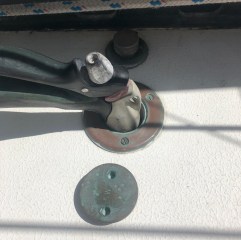
Water hull port being filled with the top below the nozzle.
At the marina, Aaron simply runs a hose from the dock spigot to a covered port on my deck that fills two stainless steel tanks located under my cabin sole (floor), holding 80 gallons each with one on port and one on starboard and going down deep into my hull. These tanks can be filled and used separately by opening and closing a flow valve that connects them, but if one is full and one empty it could tip me slightly to the side with the full tank (water is heavy!) and potentially affect steerage. We keep the flow valve open so the tank levels are continually equalized. But if one tank were to become compromised, we could isolate that tank easily until the situation is remedied. There are dip sticks, similar to the one used to check oil in a car, that allow us to check the amount of water in the tanks. We know the tanks are full when one of three things happen: when the galley sink overflow vent spits water, the air pressure equalizes or Tiki barks. Somehow, our little dog can sense that the tanks are full and she paces on the floorboards covering them, barking just before the “boom” of the air pressure equalizing gives us the sound signal and the vent spills into the sink.
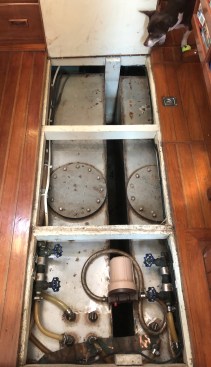
Tiki checks out my stainless steel water tanks under my cabin sole.
Each tank has a valve for pressurized use (these are the hot/cold knobs on faucets) and manual use (foot pumps); this allows for drawing of water from one tank for pressure and one for manual, drawing from both for both uses or shutting off one or the either uses completely. Pressurized uses electricity, so manual could be used to conserve energy if needed, or if the pressurized pump breaks we then have a back-up system to draw water.
Many cruisers connect the foot pumps to draw in sea water through a thru-hull (literally a hole thru the hull, connected to a tube that runs to the sinks) to conserve fresh water. Sea/salt water is used for the initial rinse and wash of dishes, then fresh water from the pressurized faucet is used for the final rinse. We probably won’t bother with this option as it’s just as easy to draw a bucket of water over my side and wash in the cockpit and then rinse in the sink or throw the pots/pans/dishes in a net bag and drag behind my stern for a good pre-wash. And on a boat, the fewer holes in the boat going into the sea, the better … trust me on this one: I like to stay above the water!


Obvious uses of water are the sinks and shower, but don’t forget about the head (toilet). Water is necessary to flush waste from the bowl into the holding tank or overboard (more about this topic in a future post). Again, landlubbers just push a handle and water appears and disappears with the waste … it’s a bit more complicated on a boat.

The hoses bring in either fresh or salt water and remove the waste from the bowl into a holding tank or overboard.
My single head has a valve that allows us to draw fresh water from my tanks or sea water from overboard for filling and flushing the bowl. While we have easy access to water via the hose, we use fresh water for flushing. When we are at sea we will use salt water to conserve our fresh water. Salt water isn’t optimal as it contains live organisms that travel in the lines going from the bowl into my waste holding tank; they can die and create a very bad smell in the lines and also continue to live in the tank. There are treatments that Aaron will use to kill these organisms and he can flush the system with fresh water every so often to keep the lines clear.
Living at the dock with both Heidi and Aaron working and going about everyday life, they don’t consciously conserve water and can still go about two weeks on 160 gallons. This is partially because when they bathe they take “military showers” so they don’t run out of hot water. They wet down, turn off the shower flow, soap up, then turn it on to rinse off. Their longest shower is about 10 minutes and both can shower without running out of hot water. They conserve hot water in the kitchen sink that way as well: soaping up all the dishes on one side and then rinsing in the other.


At sea, the conserving will be upped several notches: instead of using the shower in the head, they will soap up with salt water on deck or in the ocean, then rinse off with a fresh water sun shower (water in a bladder that is hung on the mast and warmed by the sun). They also won’t cook dishes using large amounts of water (such as boiling pasta, etc.).
Just like keeping my battery bank full for electricity needs, the goal when cruising is to keep my water tanks as full as possible. We’ll top them off with a hose or portable jugs of water when available. When these options aren’t feasible, which will be the majority of the time, we will employ a rain-catching system when we are in areas with regular rainfall and on a more regular-basis, use a water-maker.
Rain catching can be done by rigging a bucket to the end of my boom; the rain slides down the mainsail, along the boom and into the bucket. This is simple, but not very effective as the bucket can smack the helmsman in the head or tip over with movement. Heidi has seen cockpit awnings rigged with plastic tubing that drain into portable jugs, and other waterproof “scoops” that can be attached to various parts of my railings and cabintop and also collect in jugs. The jury is still out on what system we’ll be using when we cruise.

One of Aaron’s major jobs in the coming months will be to install our new water-maker. After a great deal of research and talking to other sailors who have used different systems, we decided on a Spectra Ventura 200T. Our water-maker will convert salt water into fresh water using a reverse osmosis system. The salt water is pulled from the sea via a thru-hull and passes through a series of filters that expel organisms, then a pump creates high pressure to force the water through a very fine membrane, filtering out the salt and any micro-organisms. The clean water than is filtered one more time before going into my water tanks. We also have another filter that cleans the water one final time between the tanks and the faucets.
The decision to buy this brand was based on our personal needs. It is a modular design, which will allow Aaron to install it in our very tight engine compartment, runs on 12 volt (our battery bank) as well as solar or wind power and is known to be whisper quiet. It will draw only 9 amps per hour (see our last post on electricity) and most importantly, will produce 8.5 gallons of water per hour. Running the water-maker for one to two hours each day should keep my tanks topped off and allow Heidi, Aaron and Tiki to live a comfortable lifestyle. (Needless to say, we’ll keep a good stock of replacement parts and filters on hand.) We’ll chronicle the installation of this new, vital system in the near future.
Life onboard leaves a very small footprint on our earth and we look forward to traveling the world completely self-sufficiently … dependent only on the graces of Mother Nature and Father Neptune with a good dose of common sense.
Next: Part 7 – Do you have a real kitchen?
***************************************************
One of my favorite poems:
*Water Water Everywhere
Water water everywhere and not a drop to drink
That is of course until this lovely ship does sink
There is nothing to compare to a sunrise while at sea
Oh how I’ve missed those moments special just to me
Sunrises on the ocean with no one else around
Seems to show God’s near us without a single sound
Sunsets are special too, dull moments they are not
Beautiful red colors emitting hues not too soon forgot
Night time on the ocean brings many things anew
On moonless skies it seems so cold with just a hint of dew
Of course those starry nights are quite a sight to see
The beauty of those twinklers was fashioned just for me
I’ll always miss the wonders the stars have brought to me
And when I die I’d like my ashes spread far, far out to sea
Jim 1999


 Vivo O Sonho
2 thoughts on “You Live on a Boat?! Part 6: What about fresh water?”
antonross (@antonross)
Excellent post! Looking forward to more…
LikeLiked by 1 person
Marise Phillips
I would love to take a sun-warmed shower on your deck sometime, Sonho! I always take military showers, preserving my water supplies for long soaks. Someday I hope to get a Japanese style tub. I’m very interested in all these facts and figures. Thank you for teaching us every week!
LikeLike