
“You live on a boat?! How is that? Does it move all the time? How does the weather affect you? Where do you keep your stuff? Do you have electricity? How about fresh water?Do you have a real kitchen? How do you deal with waste? Are you connected to cable and WiFi? Does your dog like living on a boat? What happens when you go sailing?”
 Do you have electricity and water? Heidi and Aaron get this question quite often. Yes, I am a boat. But I’m a finely appointed vessel, built to cruise the world. So although I don’t offer amenities such as a dishwasher and washing machine, I have systems that provide far more than a roughing-it camping experience. These systems are quite complex though, and we are very fortunate that our Captain is an electrician who understands the intricacies of maintaining my electrical system and will be well-versed on my new water-maker in the coming months.
First, let’s talk about electricity. There is a big difference between living at a marina and being at sea. In our slip at the marina I have access to alternating current (AC) via a shore power cord that connects me to an electrical box on our dock. Heidi and Aaron can plug in everyday items such as a television, speakers, hair dryer, clock, coffee maker, heater/fan, charge their electronic devices and use virtually any appliance that is used in a house. Just not all at the same time.


Similar to a house, too much cumulative use will overheat the wires carrying the electricity and trip the breakers to avoid a fire. A house has two legs of 120 volts to ground/neutral that allow for 100-200 amp usage; I have a total of 120 volts that max out with 30 amps of cumulative usage. As an example: our refrigeration runs  constantly so 7 amps are being drawn at any given time, a 1250 watt microwave will draw 10 amps and a 1850 watt hair dryer will draw 16 amps, the television is also a draw; so if you attempt to reheat something in the micro while watching the morning news and then make a cup of tea in the Keurig, the breaker will shut down my electrical system. So Heidi and Aaron need to be judicious in their use of heavy amp bearing items at the same time. Hence, they chose not to have a microwave or small appliances … other than a coffeemaker … onboard. (That, and they take up valuable space.)
My little 10 gallon hot water heater runs on AC or via the engine exhaust. This allows for hot water in the galley (kitchen) and head (bathroom) always at the dock and within an hour by running the generator or engine when we are at sea. We will be cruising mainly in warm climates, so hot water won’t be a daily need. Heidi and Aaron will use a solar shower much of time; this is a thick plastic bladder that is warmed by the sun and hung from the mast or boom and has a tube and nozzle attached to produce a water stream.
My most important systems do not run on AC; the refrigerator, lights, bilge and water pumps, and instruments all run on direct current (DC), a 12 volt system, which pulls electricity from our battery bank. Basically, this is anything that requires electricity but does not have a plug. At the dock the shore power feeds the battery charger continually, so we can use electricity without worrying about re-charging. We will rely almost exclusively on our batteries for electricity when we cruise and will need to keep them charged.


My original owners had me built with two sets of electrical receptacles: AC and 12 volt DC. The 12 volt outlets require a special plug and are most commonly used to power fans and vacuums made expressly for offshore cruisers such as we will be. New since I was built are inverters. These are devices that plug into the 12 volt outlets and convert DC to 120 volt AC, allowing Heidi and Aaron to basically use any device or appliance that they would use when connected to the dock. Inverters drain the batteries quickly but can be used without draining when the engine or a generator is running because the 120 amp alternator is continually supplying power to the battery bank. But, running the engine or a generator is noisy and uses precious diesel, so inverters are used with a dose of good judgment and only when needed. (Such as when Heidi’s electronic devices need charging!)
There are several options to generate electricity outside of shore power and running the engine to charge the batteries:
 Portable generator (as mentioned above). This simulates being plugged into shore power but is a very noisy option that isn’t welcome in quiet coves amongst other cruisers. This is usually the only option used by power boaters and is quite annoying when enjoying a breakfast or a cocktail in the cockpit and the boat upwind from you decides to crank up the generator. Ugh! We do have a generator onboard and will use it when the other options aren’t available or desired.
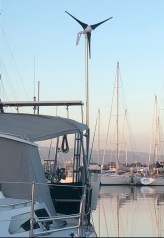 Wind generator. This system can generate between five to ten amps per hour but is only efficient when the wind is blowing. Some models require a steady 15 knot wind to operate, which isn’t always available. We will install a wind generator to use in conjunction with solar panels … having options in case one system goes down is optimal.
- Solar panels. This is the most popular option of electricity generating systems used by cruisers so I’ll share a bit more info on it below.


In the past decade solar panels have evolved from large, heavy, expensive systems to availability in a variety of sizes, a decrease in price and ease in installing. They used to be rigid and had to be positioned with every inch of the panel exposed to sunlight. Now they are flexible (and can even be walked on!) and the site of installation has far more options. The most important improvement is that charge by the individual cells in the panel instead of the panel in entirety. If shade falls on a portion of the panel, the rest of the panel is still charging.


We don’t have solar panels currently but it’s on our “must have” list of projects for the next year. (All solar panel pics are from friends’ boats at Marina Village Yacht Harbor, Alameda, California.) To determine how many and what size solar panels are needed, we will figure our usage needs and then calculate the amount to reach that need. Our lifestyle away from shore power will change greatly: Heidi and Aaron won’t be watching television each night or using many electronic devices and appliances that they use for land life. They’ll conserve even more than they do now when they go away for a weekend at Angel Island.
Our goal will be to not ever drain the batteries down to less than fifty percent, but to keep them topped off by solar and wind. If Mother Nature doesn’t cooperate, then we’ll use the engine or generator. By doing so, we will extend the life cycle of the batteries and always have a full bank of electricity should we need it.
Battery life example: If a battery has a 1,000 cycle lifespan, you can drain it down to zero and then recharge it 1,000 times. If you drain it down to fifty percent or greater, you can recharge it 2,000+ times. So keeping the batteries as fully charged as possible is important.


With our refrigerator running full time, electronics full time at sea (including the heavily relied upon auto-pilot) and lights at night (with both regular white light and red light for use at sea), we will need to generate upwards of 200 amp hours per day to keep our current battery bank of 480 amp hours full. To accomplish this, solar and/or wind systems must collect power for approximately eight hours a day or we will need to run my engine for two hours, or we’ll rely on a combination of these. Of course, if we use less, then we need to charge less.
We also have several small stand-alone solar-charged devices that aren’t tied to the me: tiki torches in our cockpit, a small charger for USB charged devices (head phones, Bose speakers, phones and computers) and an inflatable floating light that’s great for taking on dinghy rides or reading in the evening in the cockpit.


Long post, but you asked! 🙂 Electricity is probably the most complex of all my systems and second only to water in being the most crucial for living at sea. We are so blessed with having a proud Union Electrician as our Captain (who edited this post for accuracy)!
Shocking Electrical Facts:
DC is always in push mode and is never in negative. It has a straight sine and when one comes in contact with DC they receive a shock that is a quick “zap” that pushes them away from the electricity.
AC is cyclical; it has a curved sine wave that arches up into positive and then slopes down into negative and then back up and down rhythmically. When one comes in contact with AC they receive a shock that is a vibration; it is drawn to the water in our bodies and constricts our muscles. The current has to literally be broken/interrupted by separating the person from the source for the shock to stop.
Next: Part 6 – What about fresh water?


 Vivo O Sonho
3 thoughts on “You Live on a Boat?! Part 5: Do you have electricity?”
Bonstone
This was a fun read! I guess I am more of a technical nerd than I thought. I am stoked for you all and your adventures at sea!!!
LikeLiked by 1 person
Marise
This is the most informative and one of my favorite posts of all. You are a marvel, Sonho!! I learn so much from you.
LikeLiked by 1 person
SV Sonho
Thank you! It’s the tough posts that are the most rewarding! The Retreat helped me to overcome the fear I had in getting technical. With the work happening on the boat in the next few months, there will be plenty of fodder for future posts!
LikeLike